10 Best Chinese Food In Tiong Bahru | Local Guide (2026)
Chinese food is what Tiong Bahru was built on. Before the bakeries, the cafes and the conservation area reputation, this was a Hokkien and Cantonese working-class neighbourhood where the daily food was curry rice, lor mee, wonton mee, char kway teow and wok-cooked zi char. That food still exists here in the market, in the void deck restaurants along Tiong Bahru Road, in the roast meat stalls and noodle hawkers that open before sunrise and close by noon.
This guide covers 10 Chinese food options across every format and price tier from a 78-year-old curry rice institution to the wok-cooked zi char dinner that the neighbourhood’s residents eat, to the formal Chinese restaurant options a short MRT ride away.
Hawker Institutions Chinese Food at Its Most Specific
Three hawker institutions in Tiong Bahru represent Chinese food at a quality and specificity that no sit-down Chinese restaurant in the planning area approaches. All three have been operating for decades. All three are morning-focused. All three require timing to experience at their best and all three are worth planning a morning specifically around.
Loo’s Hainanese Curry Rice
Loo’s Hainanese Curry Rice has operated from the same ground-floor shop unit at 78 Tiong Bahru Road since 1946. It is one of the longest continuously operating food addresses in Singapore. The format is Hainanese curry rice a Singapore Chinese tradition that has no precise equivalent in any Chinese regional cuisine: steamed white rice with a selection of braised and curried dishes assembled at the counter and poured with curry gravy. Standard selection: braised pork belly (lor bak), braised cabbage (lor bai cai), pork chop in curry sauce, braised egg, steamed egg, fu rong egg, prawn. You point at what you want and the stall operators build the plate.
The curry gravy is the most important element a distinctive, mildly spiced curry sauce that has evolved from the Hainanese immigrant tradition into something specific to this style of cooking. It is poured over the assembled plate so that the braised dishes, the rice and the curry are eaten together rather than separately.
Do not eat each component in isolation the combination is the dish. Ask for extra curry gravy poured over the rice by saying “more curry please” at the counter; the default portion is modest. The braised pork belly (lor bak) is the anchor item: braised slowly until the fat has rendered and the meat is yielding, the skin slightly gelatinous. The pork chop in curry is the second essential order a thin-cut pork chop battered and fried, then simmered in the curry sauce until the coating has absorbed the flavour.
The queue at noon on a weekday is 30–40 minutes. The correct strategy: arrive at 11am to 11:15am, when the stall opens and before the queue builds. The first 20–30 minutes of service gives you the full selection at peak quality the braised dishes freshly transferred from the overnight cooking, the curry gravy at its most aromatic before it has been ladled repeatedly across hundreds of plates and reduced in flavour concentration. By 12:30pm, the most popular items (lor bak, pork chop) sell through, and the selection narrows. Loo’s closes when the day’s food is sold, typically 2–3pm. Closed Mondays.
Order This
Braised pork belly (lor bak) the essential order · Pork chop in curry the second essential · Braised cabbage (lor bai cai) the correct vegetable alongside the pork · Braised egg + steamed egg order both for $6–8 total plate · Say “more curry please” when the stall operator is about to pour the gravy · Mix the curry into the rice from the first bite do not eat components separately
Brandon’s Tip
Arrive at 11am on a Tuesday, Wednesday or Thursday. These are the quietest days. You will walk straight to the counter with no queue, the full selection will be available, and you will eat at one of the plastic tables on the five-foot way outside with the Tiong Bahru Road residential blocks visible across the street. That is the experience eat what has not changed since your grandparents’ generation, in a neighbourhood that has changed enormously around it.
Tiong Bahru Market Hawker Noodle Stalls
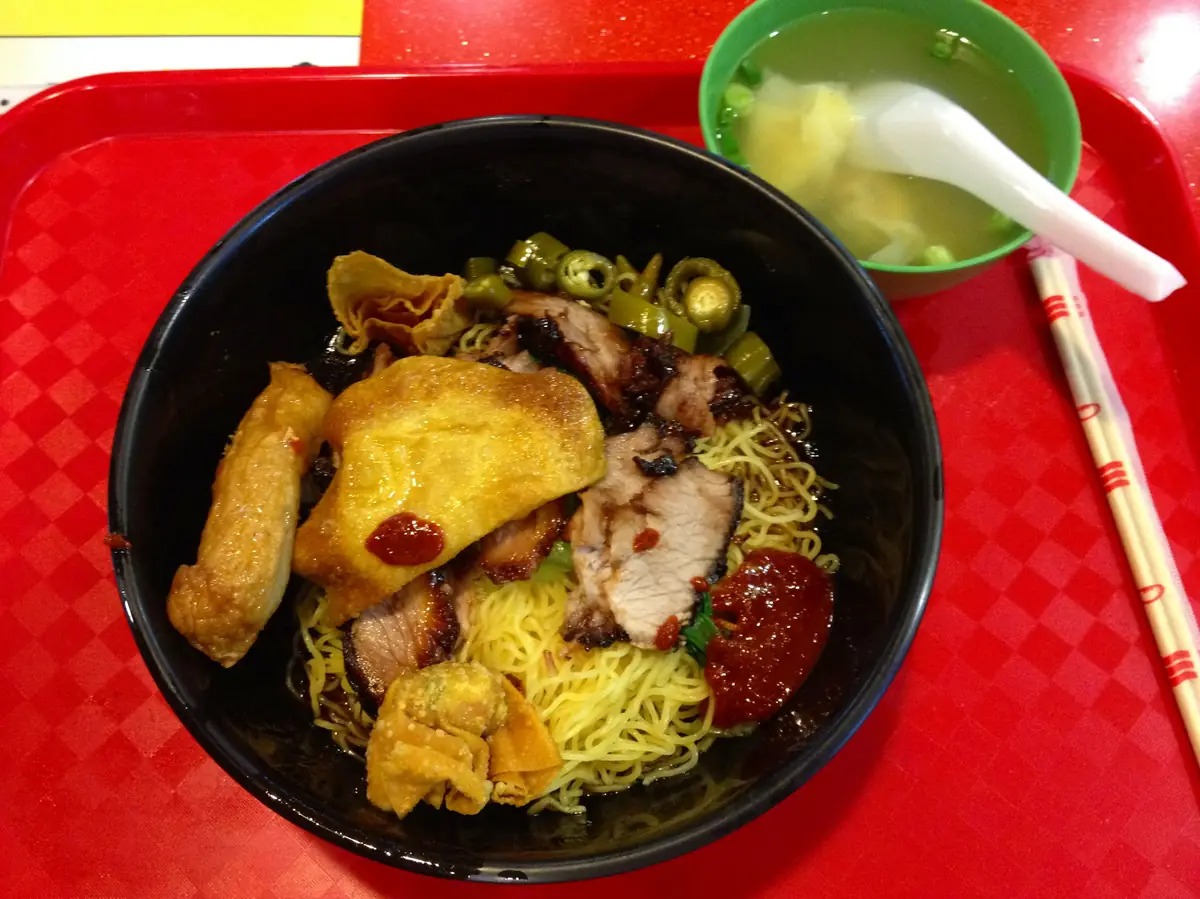
The Tiong Bahru Market hawker centre has several noodle stalls serving the three essential Singapore Chinese breakfast noodle formats: wonton mee, lor mee and fishball noodle soup. Each is distinct in flavour and format understanding which to order requires knowing what you want from the noodle experience.
Wonton mee (云吞面) thin yellow egg noodles with hand-made wonton dumplings (pork and prawn filling, wrapped in a thin skin), char siew (Chinese roast pork, sweet and lacquered), and blanched leafy greens, served dry-tossed or in broth. The dry version is the resident order: noodles tossed in a sauce of dark soy, sesame oil and a small amount of lard, with the wontons and char siew arranged on top.
The lard is the controversial ingredient that makes the dry wonton mee taste better than any substitute it binds the sauce to the noodles in a way that vegetable oil cannot replicate. The hand-made wonton is the quality test: commercial pre-made wontons are identical regardless of stall; hand-made wontons have a filling that has been seasoned specifically and a skin that has the slight roughness of fresh pasta.
Lor mee (卤面) thick yellow noodles in a dark, starch-thickened braising gravy made from pork stock, soy and five-spice, topped with braised pork slices, a hard-boiled egg, fried fish cake and crispy fried shallots, finished with a vinegar splash and sambal chilli. A substantial, heavily flavoured morning noodle. The gravy is the defining element: properly made lor mee gravy is nearly opaque with the starch thickening, deeply savoury, and reduced enough that it coats the noodles rather than pooling at the bottom of the bowl. Best at the Tiong Bahru Market between 7:30am and 10am when the gravy is at peak concentration; later in the day it thins as the stall adds water to maintain volume.
Fishball noodle soup handmade fishballs (the key distinction: commercial fishballs are uniform, processed spheres with a rubbery texture; handmade fishballs are slightly irregular, with a springy, fresh-fish bounce) in a clear or spicy broth with noodles. The handmade fishball test: squeeze gently. It should yield slightly and spring back. Commercial fishballs do not spring back they compress and stay compressed. The fishball mee pok (flat noodle) dry version, with a sambal and pork lard sauce, is the preferred form at the best stalls.
Order This
Wonton mee dry (干捞) specify “干捞” or “dry” at the stall · Ask if wontons are hand-made · Lor mee arrive before 9am for the thickest gravy · Fishball noodle: squeeze a ball before ordering to check hand-made springs back, commercial does not · Add sambal chilli from the stall’s condiment tray to any of the above · $4–5 per bowl is the market price
Jian Bo Shui Kueh Chwee Kueh
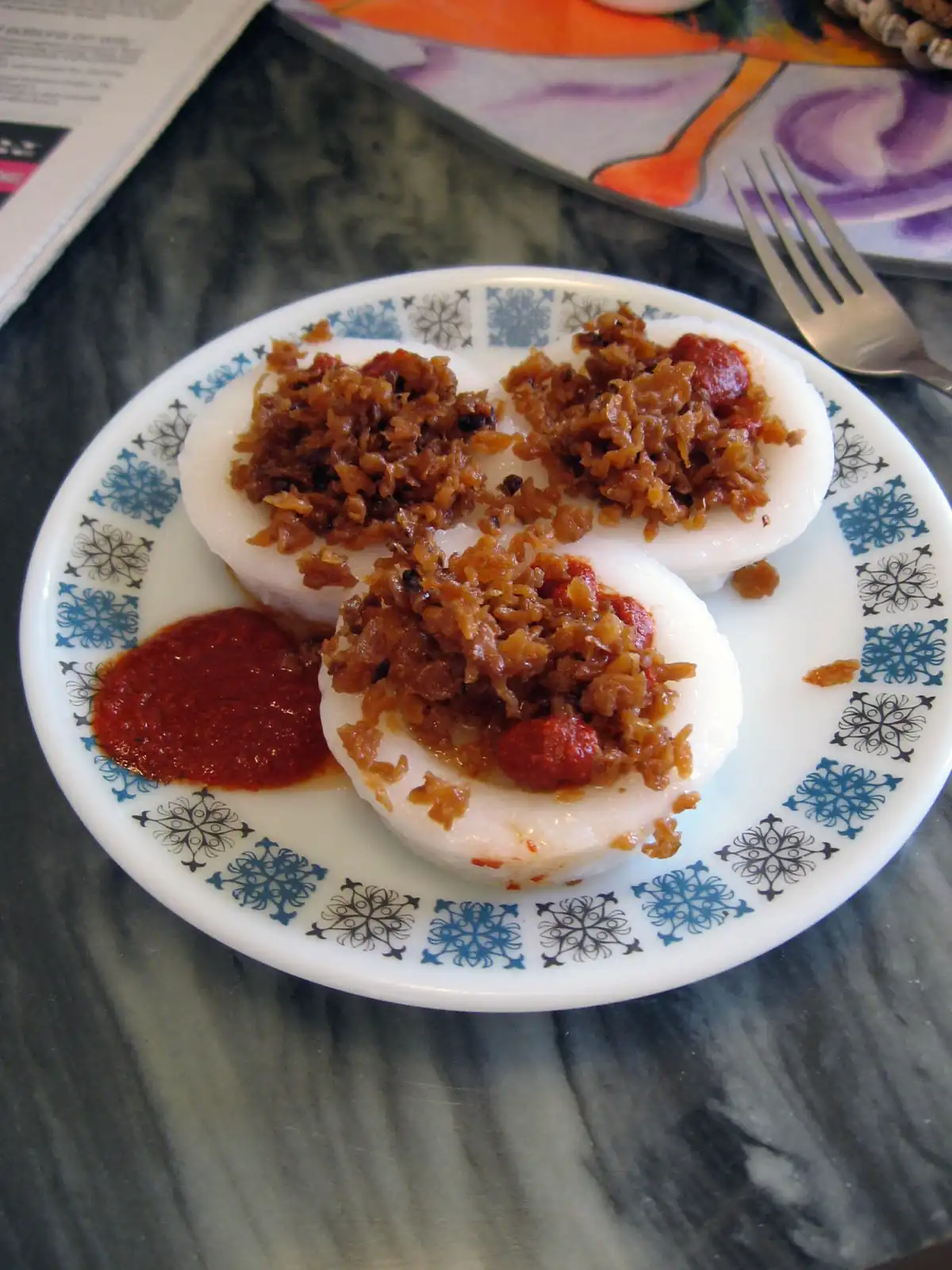
Jian Bo Shui Kueh has operated at Tiong Bahru Market for decades. Chwee kueh (水粿, “water cake”) are small steamed rice cakes soft, silky, white discs made from rice flour and water steamed in individual moulds served at room temperature topped with chai poh (salted preserved turnip, stir-fried with oil, chilli and garlic until sticky and slightly caramelised) and a light soy sauce.
The chai poh is the flavour carrier: the rice cake itself is almost flavourless its role is textural, providing the soft, cool, slightly yielding base against which the punchy, slightly spicy, sticky turnip topping registers. They are eaten together in a single bite, the rice cake picked up with a skewer, the chai poh piled on top.
Chwee kueh is technically a Chinese hawker item in the Teochew tradition but it belongs specifically to Singapore rather than to any regional Chinese cuisine. Chai poh (菜脯) is a Teochew preserved vegetable, and the format of steaming soft rice cakes and serving them with preserved radish accompaniments has its closest relatives in Chaozhou cooking but the specific Singapore version, with the chilli-fried chai poh rather than the plainer salted version, is a local adaptation. At $1.80 for three pieces, it is one of the cheapest genuinely good food items in the planning area.
The freshness window: chwee kueh are best within an hour of steaming. As they cool, the rice cake firms slightly and the chai poh loses the warmth that makes it most aromatic. Jian Bo starts the morning batch from 6:30am; buying between 7 and 8:30am gives you the kueh at optimal temperature. The stall is closed Tuesdays. On popular mornings (weekends, school holidays) the queue can extend to 20–30 minutes arrive before 8am to avoid it.
Order This
6 pieces minimum ($3.60) 3 pieces is too few for the full experience · Extra chai poh on the side ask for “more chai poh” at the counter · Eat immediately at the market table · Pair with kopi-o (black coffee with sugar, $1.20) from the drinks stall · The sambal chilli on the side of the tray: dip each piece before eating not optional
Roast Meats & Chicken Rice
Chinese roast meats and chicken rice represent the other pillar of Tiong Bahru’s Chinese food identity the counter-service format where the protein is prepared in advance (roasted, braised or poached), displayed at the counter, and served over rice with sauces. Two entries cover the roast meat and chicken rice options inside the planning area.
Market Roast Meat Stalls Char Siu, Siu Yuk, Roast Duck
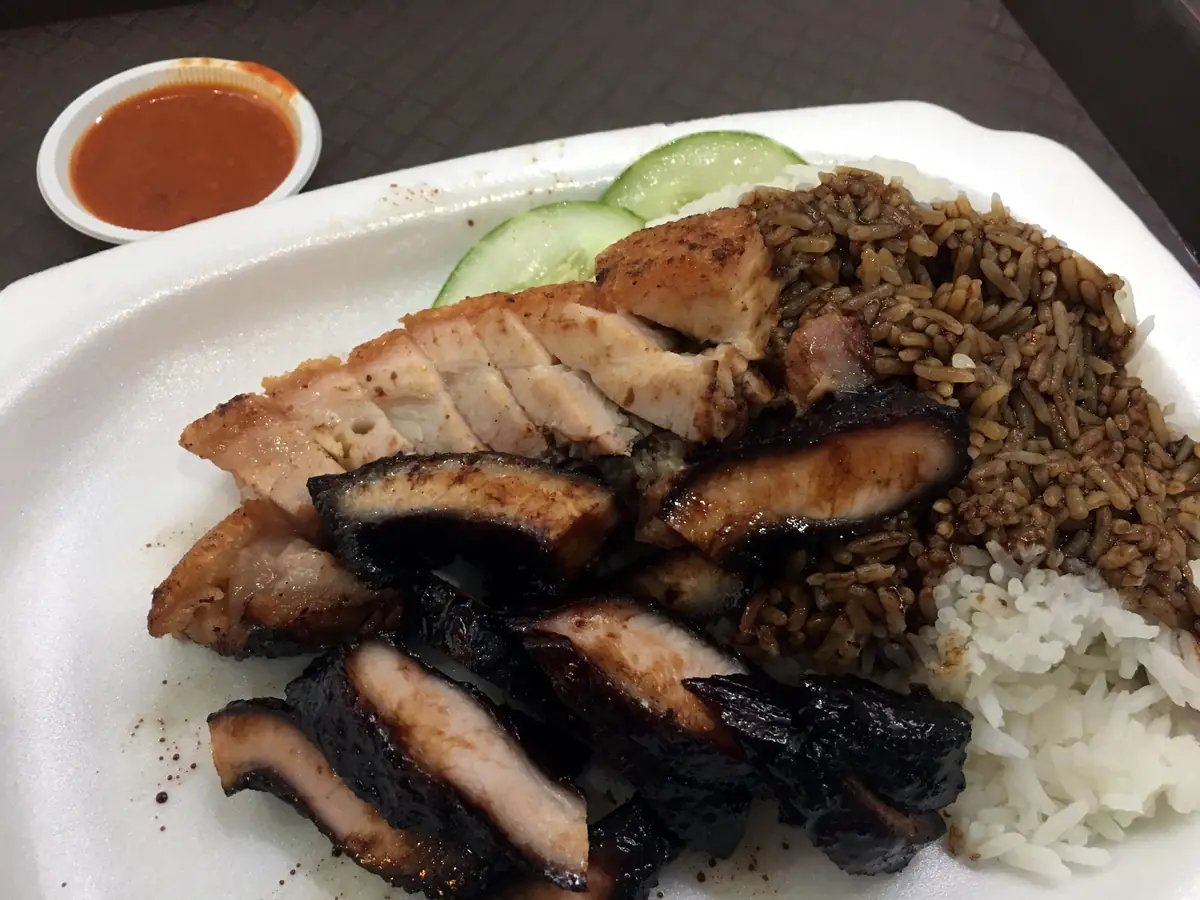
The Tiong Bahru Market roast meat stalls represent the Cantonese siu mei (烧味, roast meat) tradition the glass-case display of barbecued, roasted and braised meats that is the most visually distinctive element of any Singapore Chinese market. Three meats define the Tiong Bahru Market stalls: char siu (叉烧, Cantonese barbecue pork), siu yuk (烧肉, Cantonese roast pork belly), and roast duck (烧鸭).
Char siu pork shoulder or belly marinated in honey, soy, hoisin, five-spice and red fermented tofu, then roasted in a high-heat oven until the exterior caramelises into a lacquered, slightly sticky, sweet-savoury crust. The interior remains moist. The char on the edges the bits that have caught additional heat at the oven’s hottest points is the most flavourful part. Order the mixed cut (half fatty, half lean) for the best range of texture. Ask for extra char siu sauce poured over the rice: the cooking juices reduced with soy and honey are better than any bought sauce.
Siu yuk roast pork belly with the skin blistered and crackling. The skin is the point: a well-made siu yuk has a skin that shatters when cut, giving way to a layer of fat that has rendered slightly during roasting, and then the lean meat below. The test at any siu yuk stall: does the skin shatter audibly when the chopper goes through? At a good stall, yes. At a mediocre one, the skin is soft or chewy roasted at insufficient heat or allowed to sit too long after roasting.
Roast duck the most technically demanding of the three, requiring a specific preparation (inflating the duck skin from the meat with air before roasting so the skin crisps separately) and the longest roasting time. A properly roasted duck has crisp skin, meat that is cooked through without drying, and a complex flavour from the marinade absorbed during the overnight preparation. Serve over rice with the braising juices and a portion of plum sauce on the side.
Order This
Mixed siu mei plate: char siu + siu yuk over rice the standard two-meat order · Ask for extra sauce poured over · Roast duck as a third item if appetite allows · Eat at the market table immediately roast meats cool and the skin softens rapidly at room temperature · Add sambal chilli from the condiment tray alongside the plum sauce
Hainanese Chicken Rice Market & Estate
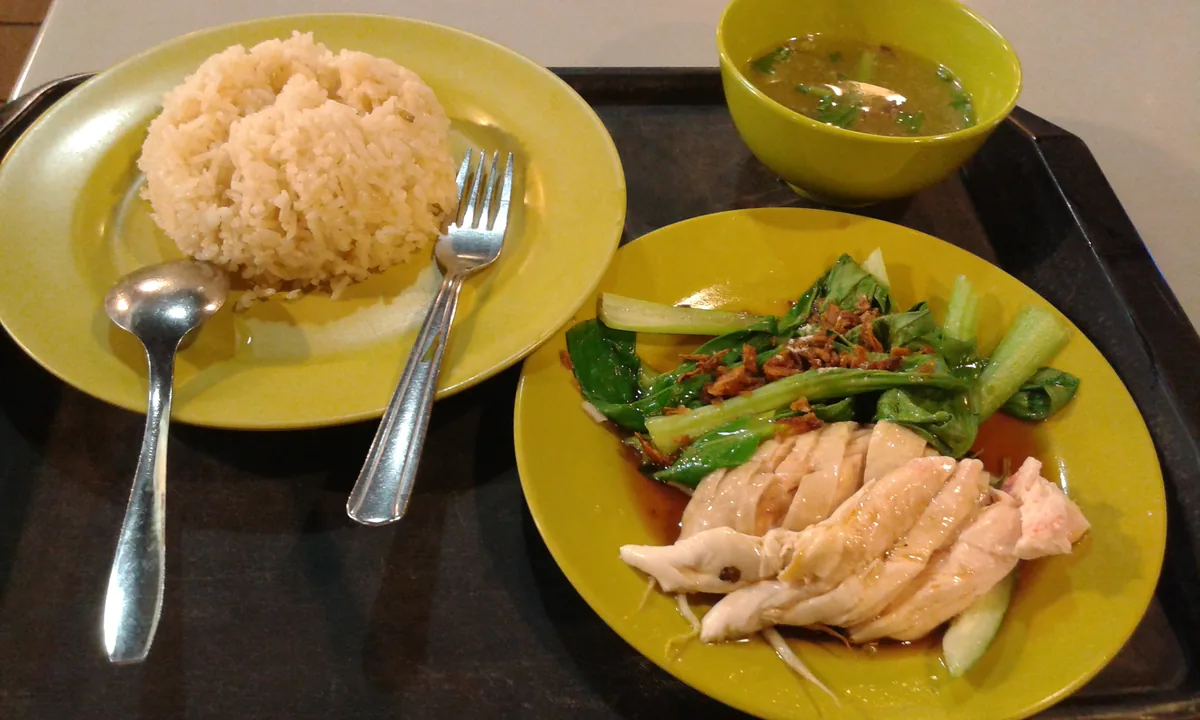
Hainanese chicken rice Singapore’s unofficial national dish is available at multiple points in the Tiong Bahru planning area. The format is so simple that the quality differences between stalls are entirely a function of execution precision: poached or roasted chicken over fragrant rice cooked in chicken stock and ginger, served with three sauces (chilli-ginger, dark soy, ginger-sesame oil) and a clear chicken broth on the side. Every component is simple; none tolerates imprecision.
The chicken rice test: the rice. Chicken rice cooked correctly uses the rendered fat from the poaching process in the rice preparation this is what gives the rice its fragrance and slightly sticky, cohesive texture. Rice that has been cooked in plain water and merely served alongside chicken is not chicken rice; it is rice with chicken. The rice should be aromatic enough that you can smell the ginger and chicken fat from across the table.
The poached chicken should be silky not rubbery, not pink at the bone. The chilli sauce should be fresh, with a balance of heat, lime acidity, and the sharpness of ginger. Dark soy provides the saline contrast. The trio applied proportionally across each bite is the correct eating method.
At Tiong Bahru Market, the chicken rice stall opens around 10:30–11am and runs until sold out. The queue at noon is 15–25 minutes. Arrive between 11 and 11:30am for the best selection (both poached and roasted chicken available) and a manageable queue. The estate also has chicken rice stalls in the void deck coffee shops along Tiong Bahru Road and Kim Tian Road these are the neighbourhood resident versions, open slightly different hours, often with less queue than the market stall at peak times.
Order This
Specify chicken type: poached (白切鸡) for the silky texture and clarity of flavour, or roasted (烧鸡) for richer, more complex taste · Mixed plate (half poached, half roasted) on your first visit to understand the difference · Rice portion: one scoop is standard; ask for more if appetite requires · Extra chilli sauce ask “more chilli please” · The clear soup is typically included if not, ask for it specifically
Zi Char Chinese Wok Dinner Restaurants
Zi char (煮炒) is Singapore’s informal Chinese restaurant format multiple sharing dishes cooked to order at extreme wok heat, served to the table over an extended dinner. It is the evening equivalent of the hawker centre’s morning food: casual, affordable, designed for groups, and entirely dependent on the wok heat (wok hei) that commercial burners achieve and home stoves cannot. Two levels of zi char are available from Tiong Bahru: the estate’s own void deck restaurants, and the more developed options in adjacent Bukit Merah.
HDB Void Deck Zi Char Restaurants
The Tiong Bahru HDB estate has several informal Chinese restaurants operating from void decks and ground-floor shop units of the residential blocks specifically along Tiong Bahru Road and Kim Tian Road. These are not in international food guides. Their menus are written in Chinese on whiteboards. Their customers are residents who eat here on weeknights and family occasions. A table of four with four sharing dishes, rice and Tiger beer runs $50–70 total. This is the Chinese restaurant experience that is more specifically Tiong Bahru than any entry elsewhere in this guide, and it is the one that most visitors never discover.
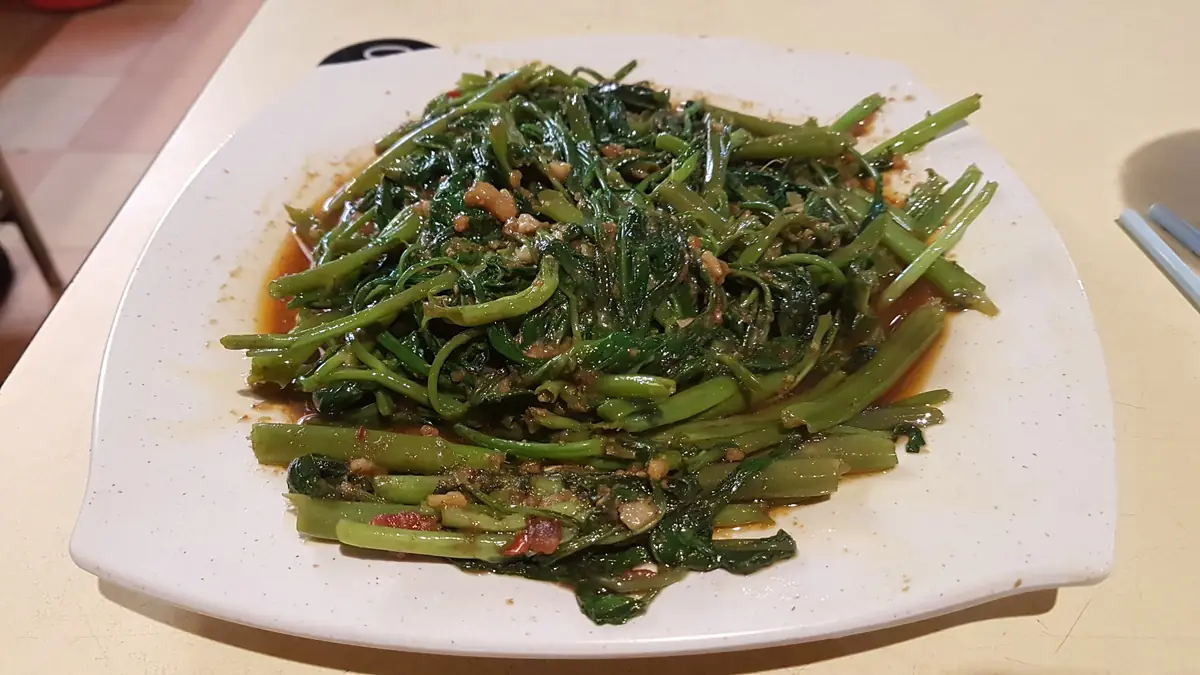
The wok hei test is the most reliable quality indicator at any zi char restaurant: order sambal kangkong (water convolvulus stir-fried with sambal chilli, dried shrimp and garlic) as the first dish and assess the result. Correct wok hei produces kangkong that arrives still sizzling with charred stems and a concentrated, slightly sticky sauce reduced by the wok’s heat. Watery, pale kangkong with no char indicates the wok is not at temperature the kitchen is not performing at the correct level. If the kangkong passes this test, proceed to the more expensive prawn and protein dishes. If it fails, the kitchen will underperform on everything more demanding.
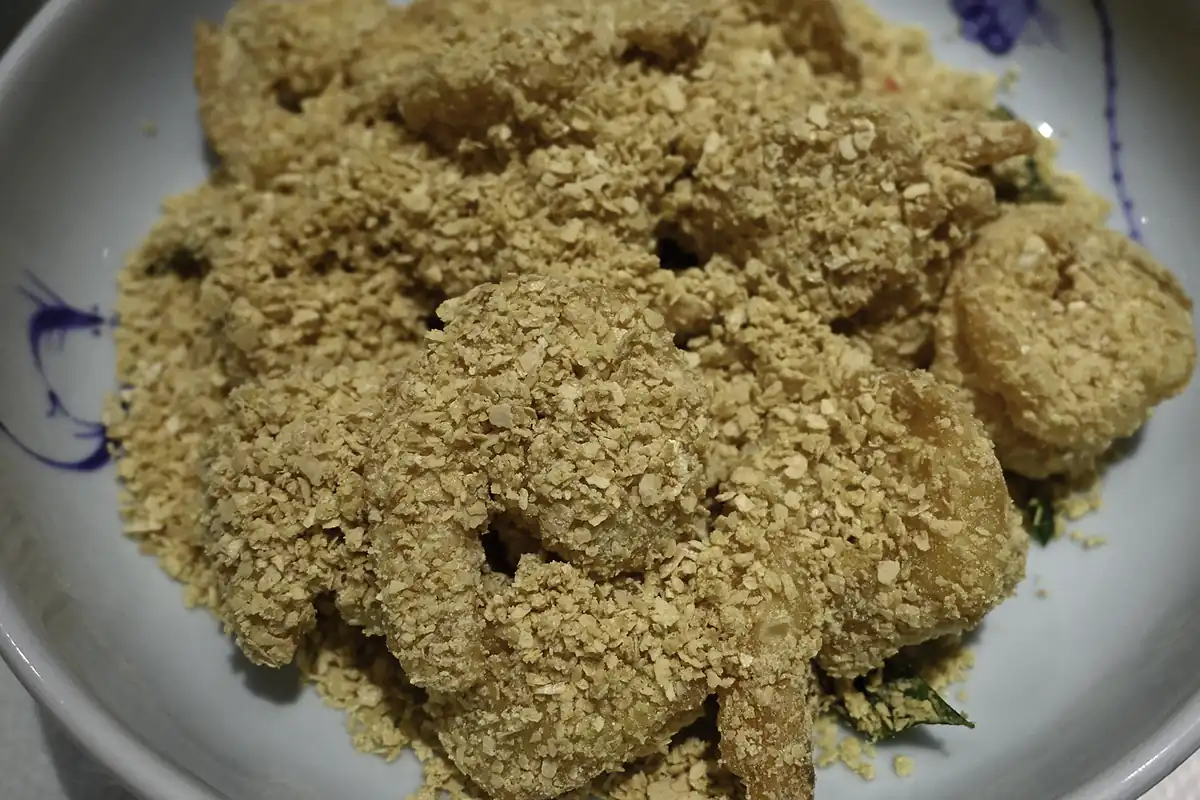
The five essential zi char orders for any table: cereal butter prawns (麦片虾 whole prawns wok-fried in a toasted oat cereal and butter coating, uniquely Singaporean, impossible to make at home without a commercial wok burner), sambal kangkong (quality test and essential vegetable), tofu with minced pork (silken tofu in a savoury minced pork sauce, textural contrast), Hokkien mee (thick yellow noodles wok-fried in prawn and pork stock, one of Singapore’s most technically demanding hawker dishes), and fried rice as the closing starch. Order in two rounds to give the wok proper attention for each dish.
Order This (Table of 4)
Round 1: Sambal kangkong (quality test) + cereal butter prawns · Assess the kangkong before ordering Round 2 · Round 2: Tofu with minced pork + Hokkien mee · Fried rice as the closing dish · Tiger beer from the restaurant cooler ($6–8 per can) · Total for 4: $55–70 · Ordering tip: use Google Translate camera on the whiteboard menu the staff are accustomed to this and will confirm dishes
Finding the Restaurants
These are found by walking the estate rather than following a map pin. Walk along Tiong Bahru Road and Kim Tian Road in the early evening (5:30–6:30pm) and look for red plastic chairs on the void deck, whiteboard menus in Chinese, and wok smoke at the ground-floor restaurant units. The restaurants that have the most plastic chairs outside and the fullest tables are the correct ones to choose resident patronage is the best quality indicator available without eating there first.
Bukit Merah Zi Char Keng Eng Kee & Alexandra Road
The Bukit Merah planning area adjacent to Tiong Bahru has a higher density of established zi char restaurants with longer operating histories and more developed reputations for specific dishes. The most significant of these is Keng Eng Kee (KEK) at Alexandra Road one of Singapore’s most praised zi char restaurants, with a following that requires booking tables 2–3 weeks ahead for weekend dinners and generates genuine media coverage for its wok hei quality and signature dishes.
Keng Eng Kee’s signature dishes include the Marmite pork ribs (pork ribs coated in a Marmite-based glaze, the umami depth of the yeast extract combined with the caramel sweetness of the reduction creating something more complex than the individual components suggest), the claypot tofu (silken tofu in a superior stock-based sauce with seafood toppings, served still bubbling in the claypot), and the Hokkien mee (thick noodles in the prawn-pork stock that defines the dish, cooked at the wok heat that most Singapore zi char restaurants only approximate). The restaurant is a useful reference point for understanding what zi char can achieve at its best, beyond the casual estate versions above.
The distance from Tiong Bahru is 10–15 minutes by Grab ($6–10 depending on surge). The booking situation for KEK is the limiting factor: walk-in is frequently not possible for weekend dinners, and the week-ahead booking requirement means planning in advance. For visitors who want a serious zi char dinner and are willing to commit to a booking, KEK is the correct destination. For visitors who want zi char without planning, the estate void deck restaurants (entry #6) are available without booking any day of the week.
At Keng Eng Kee
Marmite pork ribs the KEK signature, order first · Claypot tofu the textural contrast to the ribs · Sambal kangkong the quality test, even at a good restaurant · Hokkien mee the benchmark noodle dish · One cracked pepper crab if budget allows and group is 6+ · Tiger or Heineken beer from the cooler · Book 2+ weeks ahead for Friday/Saturday dinner
Book Keng Eng Kee in Advance
KEK books out significantly for weekend dinner walk-in success on a Saturday evening is close to zero. Call or book via their social media 2–3 weeks ahead for weekend sittings. Weekday evenings (Tuesday to Thursday) have better walk-in availability. If KEK is the specific goal of the evening, confirm the booking before making the Grab journey.
Nearby Chinese Restaurants MRT Distance
For dim sum, Cantonese roast meats at the restaurant level, mid-range Cantonese dining and the fine-dining Chinese restaurant experience, the Chinatown and CBD area 15 minutes from Tiong Bahru by MRT provides significantly more options than the planning area itself. Three entries cover the tiers of Chinese restaurant dining available within easy commute distance.
Chinatown Dim Sum & Cantonese Roast Meats
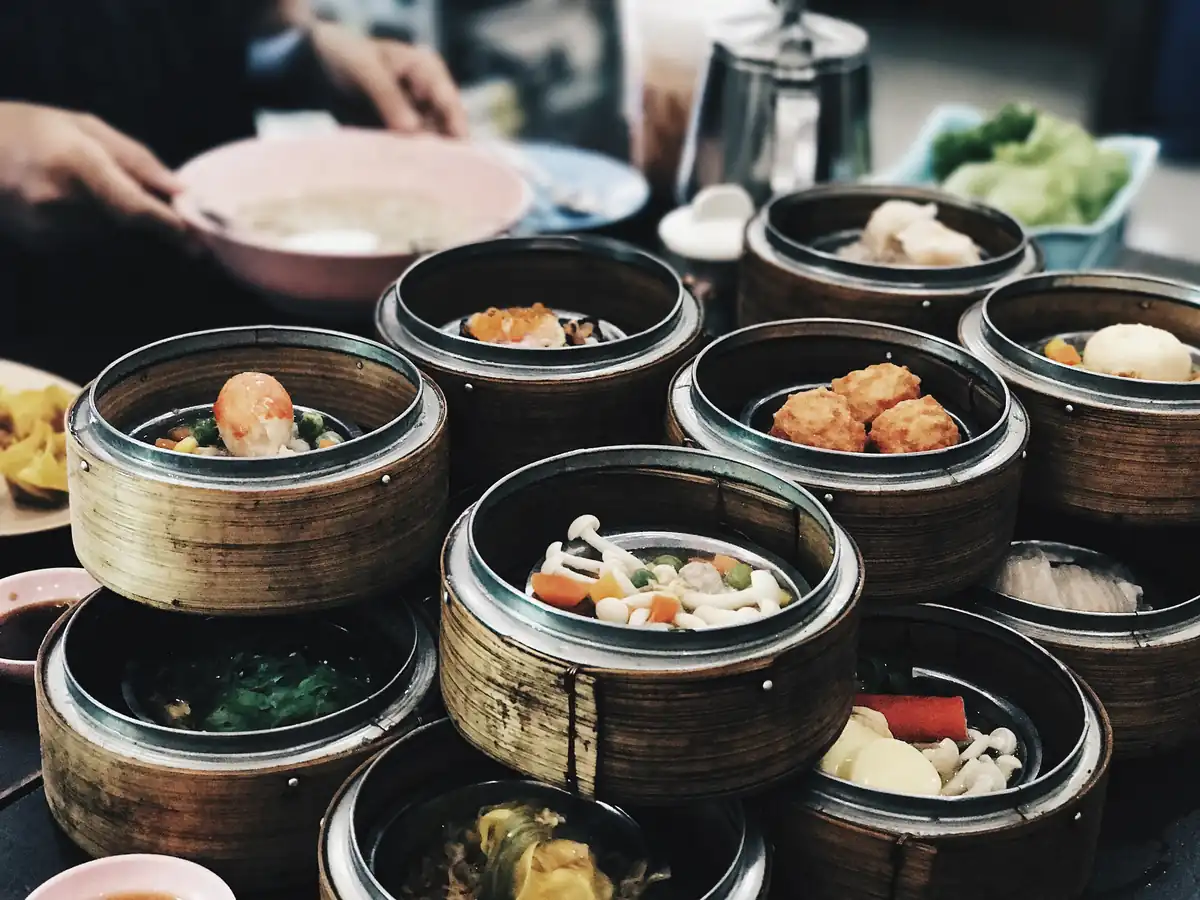
Chinatown is 15 minutes from Tiong Bahru by MRT (EW17 to EW16 Outram Park, change to NE4 or DT19 Chinatown, 5 min walk) and contains Singapore’s highest concentration of Cantonese dim sum restaurants and roast meat shops. Dim sum the Cantonese yum cha (饮茶) tradition of steamed and fried dumplings, buns and small dishes served with tea is not available at the Tiong Bahru market in the traditional restaurant format.
The Chinatown dim sum restaurants provide the full experience: har gow (steamed prawn dumplings), siu mai (pork and prawn dumplings), char siu bao (barbecue pork buns, steamed or baked), cheong fun (steamed rice noodle rolls with various fillings), lo bak go (fried turnip cake), egg tarts, and the full range of Cantonese dim sum dishes served from carts or ordered from a tick-sheet menu.
The Chinatown dim sum cluster includes restaurants across the price spectrum from the basic hawker-style tze char dim sum format at Smith Street Food Centre to the proper sit-down Cantonese restaurants on Temple Street and New Bridge Road. Weekend dim sum requires booking the Chinatown restaurants fill by 10am on Saturday and Sunday mornings, and walk-in by 11am on a weekend is likely to result in a wait. Book the Friday before for weekend breakfast dim sum; specify a 10am or earlier sitting for the full trolley service before the peak crowd.
The Chinatown roast meat shops on Smith Street and adjacent streets sell Cantonese siu mei at the restaurant quality level rather than the hawker stall level the roasting equipment, the marinade formulations and the sourcing of the pork cuts are all more developed than at the market stall format. For char siu at its most specifically Cantonese with the properly caramelised exterior and the specific Cantonese BBQ sauce profile the Chinatown roast meat shops are the correct destination.
Dim Sum Order (Classic)
Har gow (steamed prawn dumplings) the dim sum quality benchmark: thin, translucent skin, three pleats minimum, the prawn filling sweet and bouncy · Siu mai (pork and prawn, open-topped) · Char siu bao (steamed BBQ pork bun white, soft, fragrant) · Cheong fun (steamed rice noodle roll) with char siu filling · Lo bak go (fried turnip cake, crispy outside, soft centre) · Egg tart baked pastry shell with silky egg custard, warm · Pot of Pu-erh tea throughout
Crystal Jade Reliable Mid-Range Cantonese
Crystal Jade is Singapore’s most widely distributed mid-range Cantonese restaurant group multiple outlets across the island covering dim sum, Cantonese roast meats, Shanghainese cuisine and Sichuan formats under the same brand umbrella. The relevant outlets for Tiong Bahru visitors are the Cantonese dim sum and roast meat formats at accessible central Singapore locations (VivoCity, Holland Village, Orchard, and the CBD area).
The Crystal Jade value proposition: consistent, recognisably good Cantonese food at a mid-range price point ($35–55 per person) that bridges the gap between hawker stall quality and fine-dining Chinese. The dim sum (at Crystal Jade La Mian Xiao Long Bao or the main Crystal Jade outlets) is more polished than the hawker dim sum at Chinatown’s street-level restaurants but less expensive and less exceptional than the fine-dining Chinese restaurants at entry #10. For visitors who want a clean, comfortable, air-conditioned Chinese restaurant experience with a predictable quality level and no risk of disappointment, Crystal Jade is the answer.
The standout dishes across the Crystal Jade format: xiao long bao (Shanghai soup dumplings thin skin, pork and ginger filling, a tablespoon of soup inside each dumpling that must be eaten carefully without losing the broth), Cantonese roast duck, and the steamed egg white dumplings (a dim sum item at the upper end of the Crystal Jade range that requires skill to make correctly). The congee (rice porridge) at Crystal Jade is also specifically worth ordering a Cantonese congee made with proper overnight-cooked stock rather than the instant version common at food courts.
Order This at Crystal Jade
Xiao long bao (soup dumplings): bite a small hole in the side, let the soup flow into a spoon, drink the soup first, then eat the dumpling the correct method · Har gow and siu mai (steamed dim sum standards) · Roast duck over rice · Century egg with tofu (皮蛋豆腐) cold, refreshing, textural contrast · Congee (rice porridge) for something comforting · Jasmine tea throughout
Imperial Treasure & Fine-Dining Cantonese
Imperial Treasure is Singapore’s most respected fine-dining Chinese restaurant group, with multiple formats: Imperial Treasure Fine Chinese Cuisine (the top-tier Cantonese format, Michelin-starred), Imperial Treasure Super Peking Duck (Beijing duck as the anchor dish), and Imperial Treasure Cantonese Cuisine (the accessible version of the group’s standards). The fine-dining Chinese restaurant experience that Imperial Treasure offers differs from mid-range Crystal Jade in the same way that Merci Marcel differs from PS Cafe: the ingredients are more premium (live seafood, specific Hong Kong duck, day-aged cuts of Wagyu for stir-fry), the technique is more refined, the dining room is more formal, and the price reflects all of this.
The Peking duck at Imperial Treasure Super Peking Duck is the most celebrated single item Beijing-style roast duck with the skin presented separately from the meat in the first course, carved tableside, wrapped in thin pancakes with spring onion, cucumber and hoisin. The skin should be translucent and crackling when correctly roasted; the meat carved from the carcass in a second service with stir-fried preparation. This is a specific occasion dish not casual dining, not something to order on a Tuesday because you happen to be in the area.
Fine-dining Chinese in Singapore covers multiple regional traditions beyond Cantonese: Shanghainese (Imperial Treasure, Din Tai Fung at the accessible end), Sichuan, Teochew, Hokkien and Hunanese fine dining all exist at the $80–150 per person range in Singapore’s CBD and Orchard areas. From Tiong Bahru: 20 minutes by MRT to Raffles Place or City Hall, then a short walk to the Marina Bay and CBD restaurant concentration. Research current fine-dining Chinese restaurant recommendations via the Michelin Guide Singapore (updated annually) before booking.
When to Book Fine-Dining Chinese
Chinese New Year gatherings and family celebration occasions the format is specifically designed for these · When you want to understand Cantonese cooking at its most technically refined · Imperial Treasure Super Peking Duck: book 1 week ahead for weekday dinner, 2–3 weeks for weekend · Budget $100–150pp all-in for a full fine-dining Chinese dinner with tea and service charge
Full Chinese Food Summary Tiong Bahru 2026
Tips for Chinese Food in Tiong Bahru
Frequently Asked Questions
Brandon’s Verdict
Loo’s at 11am. Wonton mee at the market at 7:30am. Void deck zi char at 6:30pm. Three meals that have nothing to do with the bakeries and cafes that made Tiong Bahru famous and all of them better for understanding what this neighbourhood actually is.
The conservation area cafes and French pastry are what Tiong Bahru is famous for internationally. The Chinese hawker food is what the neighbourhood is built on and what it has been for longer than any of us have been alive. Loo’s Curry Rice at 78 Tiong Bahru Road has been serving braised pork belly and curry gravy at the same address since 1946 seven years before Singapore’s first traffic light, twenty years before independence. That is the restaurant whose loss would actually damage the neighbourhood’s identity. The kouign-amann is better by certain measures. The void deck zi char understands the neighbourhood better. I have been eating both for years and I will continue eating both. Come for the bakery. Stay for Loo’s.